|
ASTM-E595-93 Standard Outgassing Test.
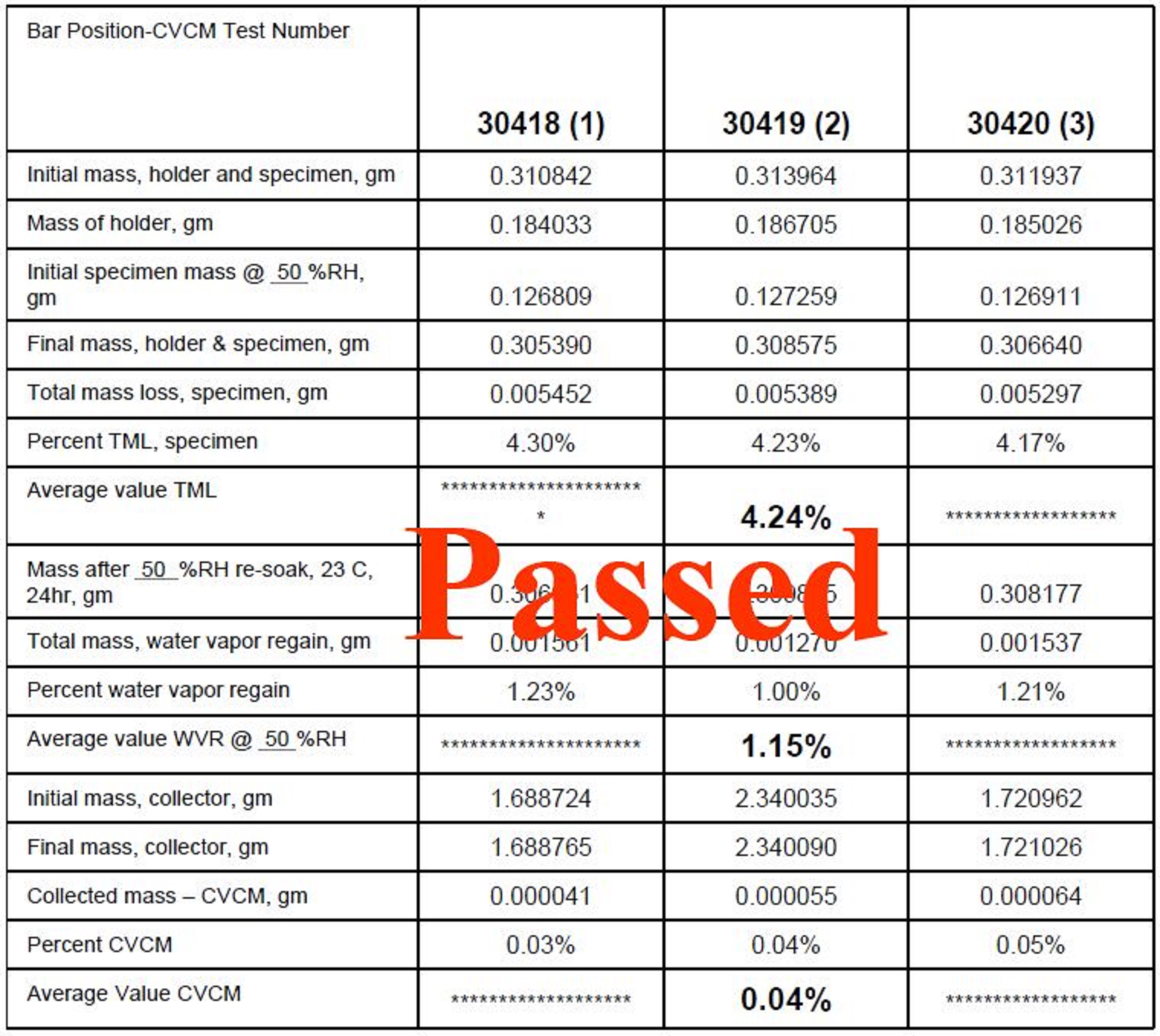
The outgassing test was performed according to the test procedures of the ... used as a screening technique to determine the volatile content of materials when exposed to a vacuum environment. The parameters to review are the Total Mass Loss (TML), the average Water Vapor Regain (WVR), and the average Collecting Volatile Condensable Material (CVCM). Standard values for TML is 1.0%,... The CVCM should be 0.1%...the most important parameter is the CVCM because this value indicates the amount of constituents that will deposit on a cold surface.
...TML is 4.24%, this indicates...a large amount of water and solvents, which is expected...At the same time, the CVCM is 0.04% which is lower than the standard 0.1%. Overall, this is a great starting point.
The outgassing test was conducted at 125C for 24 hours.
K.D.H. email to J.P.H.
|
|
Outgassing test were performed according to ASTM-E595-93 Standard Outgassing Test and are published on the NASA outgassing website1. The Total Mass Loss was found to be 4.24% which indicates a large amount of water and solvents, as expected, as it fully dries. The Condensed Volatile Material is 0.04% which is lower than the standard 0.1%. The outgassing test was conducted at 125C for 24 hours. At NASA's Jet Propulsion Lab, another analysis was performed for the Laser Interferometer Gravitational Wave Observatory (LIGO). In this report, for the LIGO Interferometer group2, "glass test surfaces were precleaned and tested to a level of less than 0.01 micrograms per square centimeter of molecular residue. The polymer solution was painted on the clean glass and set for 2 hours. The material was then peeled off the surface. The surface was sampled using dichloromethane swab/rinse. The low volatility residue (LVR) was analyzed using Diffuse Reflectance/Fourier Transform Infrared (DRIFT/FTIR) spectroscopy. FTIR provides chemical functional ground information for quantitative analysis and qualitative identification of materials. The analysis followed the ACL-120 procedure that complies with Mil-STD-1246C Notice 2 and is sensitive to the most stringent level (A/100)... The glass surface was treated with First ContactTM (applied and removed) was very clean with less than 0.02 micrograms per square centimeter of molecular residue." These results have lead to the qualification that surfaces treated with First Contact Polymers are "Space and UHV ready" with little or no organic surface contamination.
1. http://outgassing.nasa.gov/ (then) search for First Contact
2. Report LIGO-T060051-00-D R039, JPL ANALYTICAL CHEMISTRY LABORATORY, Analytical Chemistry and Materials Development Group 3531 Thermal and Propulsion Section 3530. March 2006.
"Once applied to an optic surface, it is expected that (First Contact Polymer) can be left on the surface indefinitely. The material is inert, and has no known chemical reaction with either the optic or environment. Silicon wafers coated with the material were examined with ESCA and showed no trend of degradation or residue for up to 8 months. Studies were not continued beyond 8 months, but it is expected to be compatible indefinitely."
- Lockheed Materials Specification, Lockheed Missiles and Space
Spacecraft Material Outgassing Data
http://outgassing.nasa.gov/
This compilation of outgassing data of materials intended
for spacecraft use were obtained at the Goddard Space Flight Center (GSFC),
utilizing equipment developed at Stanford Research Institue (SRI) under
contract to the Jet Propulsion Laboratory (JPL).SRI personnel developed an apparatus for determining the
mass loss in vacuum and for collecting the outgassed products. Their report
(Reference 1), which contained data from June 1964 to August 1967, served well
as a foundation for selecting spacecraft materials with low outgassing
properties. The apparatus was also constructed at GSFC and, based on the SRI
data and GSFC data, a GSFC report (Reference 2) was published. That report
included data for those materials meeting two criteria: a maximum total mass
loss (TML) of 1.0 percent and maximum collected volatile condensable material
(CVCM) of 0.10 percent.
After a series of tests and verification of procedures, an
American Society for Testing and Materials (ASTM) Standard Test Method was
developed, based upon this apparatus. The method, “Total Mass Loss (TML) and
Collected Volatile Condensable Materials (CVCM) from Outgassing in a Vacuum
Environment,” is identified as E 595-77/84/90. The data developed through the
years have been reported in References 3, 4, 5, 6, 7, 8, and 9 as a means of
assisting in selecting materials for space flight use.
- See more at: https://data.nasa.gov/dataset/outgassing-db
How Clean is First Contact Polymer?
“... no residue that produced scattering was found on a
fresh silicon wafer when the polymer [First Contact] was applied and then
stripped off.”
— Bennett, J. et al., Applied Optics, 39(16), 2737,2001
“There was no residue after any of the first contact
cleanings, as there was after the drag wiping on the previous optic.”
— See for example: “First Contact Application and Removal
Procedure” or “Drag Wiping with Methanol vs First Contact,” Caltech/MIT LIGO
Doc. E1000079_v5, T1000137_v3
Why FIRST CONTACT?
• First Contact Solutions consist of a blend of inert
polymers in a blend of solvents carefully tuned so that the dried
polymer peels with 1/10th the adhesion of scotch tape and
minimizes thermal shock and stress to coatings.
• First Contact protects the precision surface when the film
is left on, pre- venting scratching and becomes a barrier
to water vapor as well as oxygen gas, corrosives and sulfur
containing compounds. Protect your optics during
installation and transportation. When ready to use, peel!
• First Contact Polymer Solutions come in a variety of
colors as well as ESD free. Just choose the one that is best
for your application.
• First Contact works beautifully on fused silica phase
masks, diffractive optics, nano, and microfluidic structures.
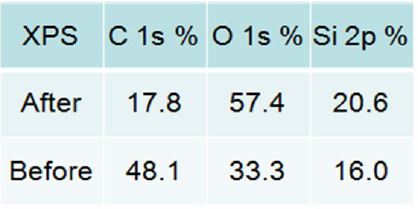
The table above shows XPS data taken on a clean glass substrate
before and after cleaning with First Contact Polymer. The amount
of carbon decreases substantially after polymer removal, it is
truly vacuum ready. Data taken at the Univ. of Iowa Central
Microscopy Facility.
|