LIGO Laboratory / LIGO Scientific Collaboration  Distribution of this document: LIGO Scientific Collaboration This is an internal working note of the LIGO Laboratory.
California Institute of Technology
LIGO Project – MS 18-34
1200 E. California Blvd.
asadena, CA 91125
Phone (626) 395-2129
Fax (626) 304-9834
E-mail: [email protected]
|
a
|
Massachusetts Institute of Technology
LIGO Project – NW22-295
185 Albany St
Cambridge, MA 02139
Phone (617) 253-4824
Fax (617) 253-7014
E-mail: [email protected]
|
LIGO Hanford Observatory
P.O. Box 159
Richland WA 99352
Phone 509-372-8106
Fax 509-372-8137
|
|
LIGO Livingston Observatory
P.O. Box 940
Livingston, LA 70754
Phone 225-686-3100
Fax 225-686-7189
|
1. Introduction
The purpose of this document is to recommend that the project adopt Red First Contact in place of
clear First Contact for cleaning optics.
2. Advantages of using Red First Contact
Using red First Contact has a few advantages over clear First Contact. One being that red First
Contact is more viscous, making it much easier to apply to a vertical optic. Also, the red color is much easier to see than the clear, making drips and gaps in coating easy to spot and clean off.
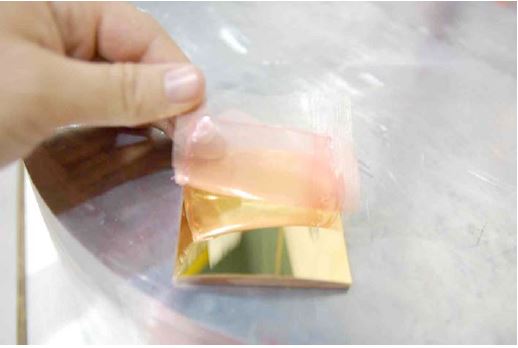
Most importantly, the red polymer can be used to clean gold coatings like the ESD and the CP
barrel. The clear version of First Contact does not work on gold surfaces, the polymer adheres too strongly to the gold and it does not come off. Any optic that has any gold on it would have to be cleaned with Red first contact.
Gold coated slide cleaned with Red First Contact and PEEK mesh
3. Performance of Red First Contact as a cleaning agent
In addition to the advantages listed above, the following raster scans compare how well the clear and red versions of first contact clean optics. Scan 1 and 2 show the difference in BRDF before and after one cleaning with clear first contact.
Raster scans of optic cleaned with Clear (Colorless) First Contact
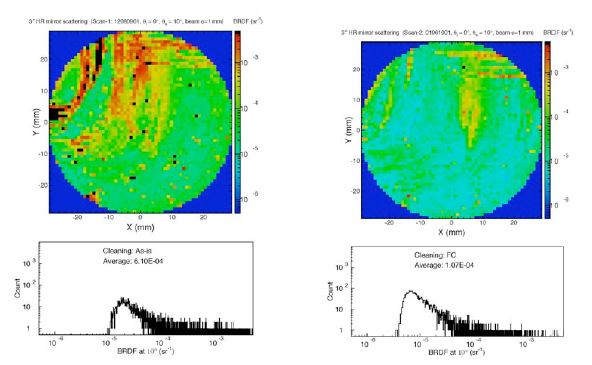 On the left is a scan of an optic before it was cleaned. The average brdf value is 6.10x10⁻⁴. On the right is the same optic after it was cleaned once with Clear (Colorless) First Contact, it’s average value is 1.07x10⁻⁴. Successive cleanings with clear first contact seemed to improve the BRDF at around the same rate. On the left is a scan of an optic before it was cleaned. The average brdf value is 6.10x10⁻⁴. On the right is the same optic after it was cleaned once with Clear (Colorless) First Contact, it’s average value is 1.07x10⁻⁴. Successive cleanings with clear first contact seemed to improve the BRDF at around the same rate.
The next two scans show the same optic as above, the scan on the left is the result of the
optic sitting unprotected in the CASI chamber for a couple weeks, then on the right after being cleaned with Red First Contact.
Raster scans of optic cleaned with Red First Contact
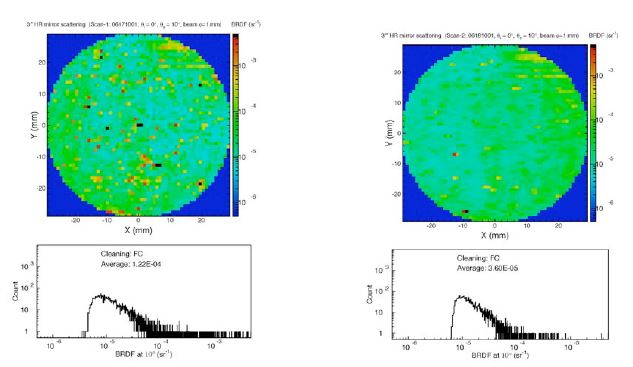
On the left is the same optic as was used above for the clear first contact tests. It sat around collecting big dust particles for a couple weeks in the CASI system, which resulted in an average BRDF of 1.22x10⁻⁴ . On the right is the BRDF after cleaning it with Red First Contact, its average value was 3.6x10⁻⁵.
Given the advantages of the Red First Contact listed above, and that the CASI results that show a comparable performance of the Red First Contact, Core Optics recommends the project adopt the red version for cleaning optics.
More results from LIGO's "Drag Wiping with Methanol vs. First Contact", LIGO-T1000137_v3
The images below are Sequential Progression First Contact BRDF Test
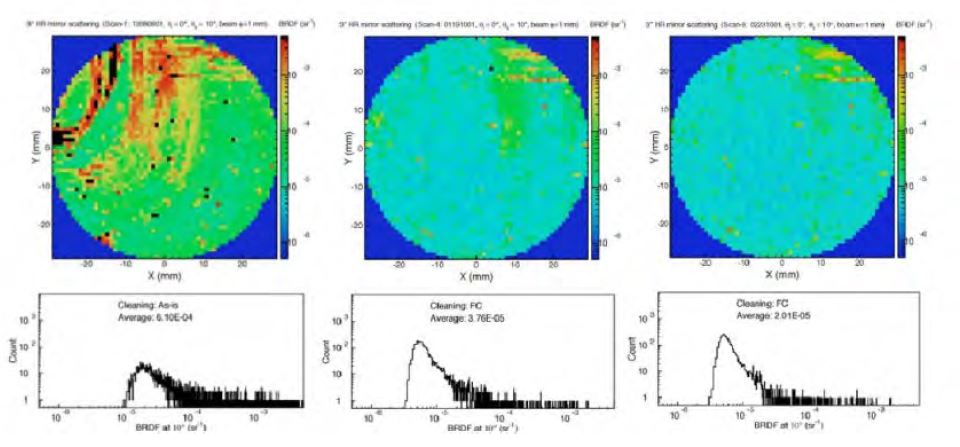
Apply. Peel. Repeat as/if needed
"A highlight of the BRDF test shows that repeated applications of FC only improves optical surfaces"
“Optical contamination control in the Advanced LIGO ultra-high vacuum system”, Margot H. Phelp, Kaitlin E. Gushwaa, and Calum I. Torriea, Proc. of SPIE Vol. 8885, 88852E · doi: 10.1117/12.2047327
-LIGO Laboratory, California Institute of Technology, 1200 E. California Blvd., Pasadena, CA
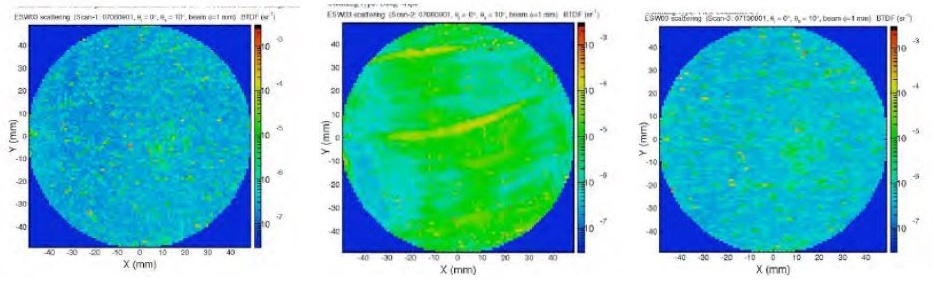
Before 2.05ppm avg BRDF --- After MeOH drag wipe 10.7ppm avg BRDF --- After FCP 2.05ppm avg BRDF
BRDF = Reflectance of a target as a function of illumination geometry and viewing geometry.
"Not only did cleaning with First Contact leave no residue, it also removed nearly all the residue left by the methanol." -LIGO Internal Report T1000137_v3
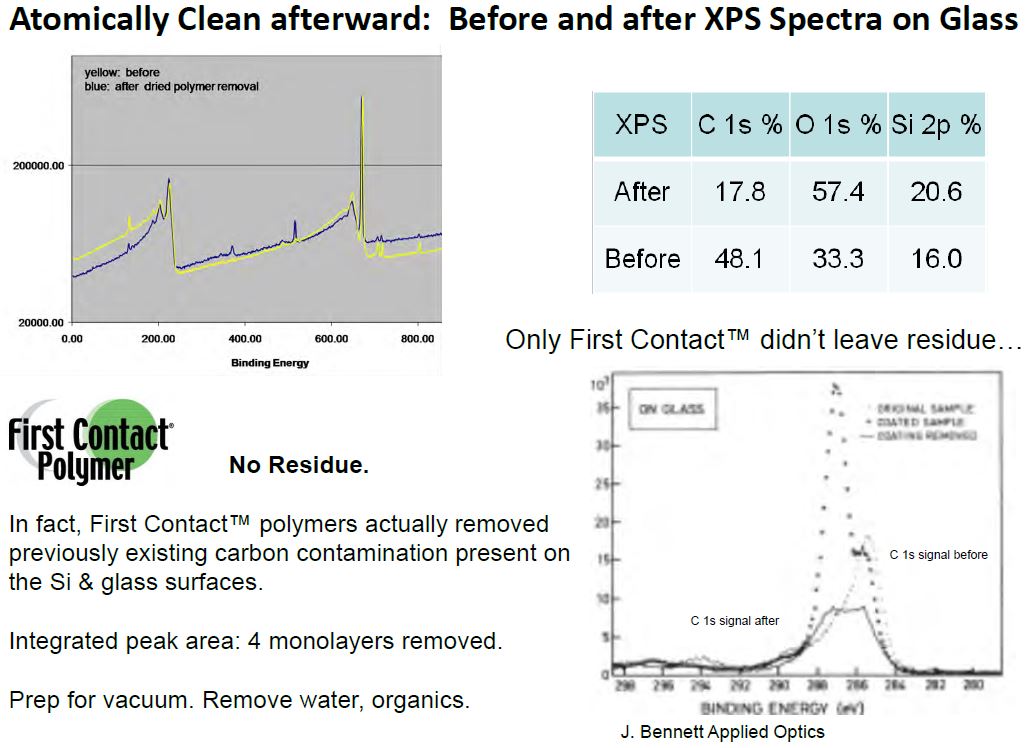
Auger Residue Analysis of Solvent Cleaning and FCP Monolayer Surface Sensitive technique
Semiconductor Clean! February 2020 Preliminary Analysis
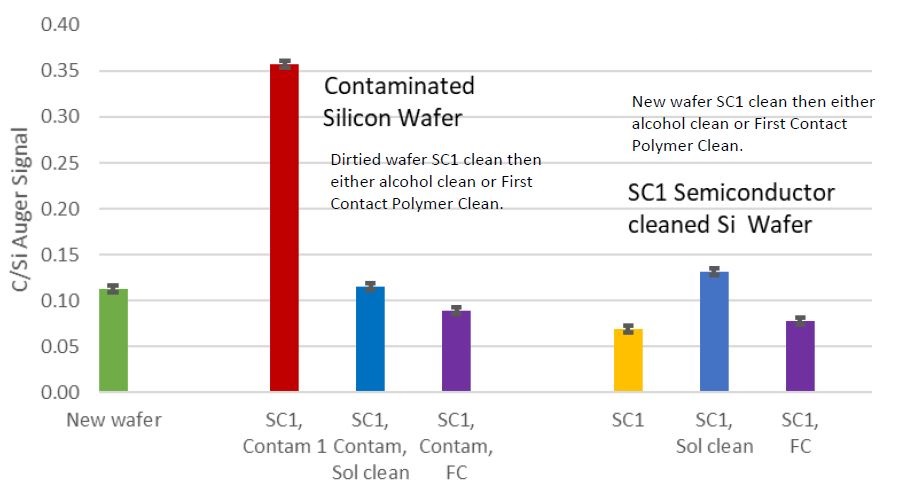
What is SC1? SC-1): organic clean + particle clean
The first step of RCA process (called SC-1, where SC stands for Standard Clean) is performed with a solution of (ratios may vary)[2] •5 parts of deionized water, 1 part of ammonia water, (29% by weight of NH3), 1 part of aqueous H2O2 (hydrogen peroxide, 30%) at 75 or 80 °C[1] typically for 10 minutes. This base-peroxide mixture removes organic residues. Particles are also very effectively removed, even insoluble particles, since SC-1 modifies the surface and particle zeta potentials and causes them to repel.[4] This treatment results in the formation of a thin silicon dioxide layer (about 10 Angstrom) on the silicon surface, along with a certain degree of metallic contamination (notably iron) that will be removed in subsequent steps. -Wikipedia, https://en.wikipedia.org/wiki/RCA_clean accessed March-06-2022.
|
aa
|
NASA Goddard SFC Materials Engineering Group completed an ESCA/XPS
analysis of two specially prepared and identical mirror surfaces, typical of those used on the
Hubble Space Telescope optics and many other instruments designed to operate at UV wavelengths
- with and without an application of First Contact cleaning solution
- Evaporated Al film (~100nm) overcoated with SiOx (~200nm)
- Mirrors were prepared 18 months prior to test and stored in an ordinary plastic box with no other protection
- They acquired surface contaminants films of the usual kind from the incrontrolled storage
- First Contact was applied to one mirror and peeled after 30 minutes
- Both mirrors were then examined with ESCA/XPS
|
Results: The ESCA data showed a measurable removal of incidental contaminant by the First Contact application when compared with other mirror, and no detectable residue left by the First Contact. NASA's CONCLUSION: First Contact performed as claimed."ESCA tests confirmed the results reported in Photonic Cleaning Technologies' literature.
Property of Photonic Cleaning Technologies
CONFIDENTIAL
Nov. 1, 2006
Jim:Goddard's Materials Engineering Group completed an ESCA analysis of two mirror surfaces, with and without an application of your 'First Contact" cleaning solution.
The two mirrors were sister samples, one inch squares, consisting of a ~1/16 in thick glass that was coated with an evaporated Al film (~100nm thick) that was then overcoated with SiOx (~200nm thick). This is a typical front surface mirror formulation.
Both mirrors had been prepared about 18 months ago for another purpose and were stored in my office in an ordinary plastic box with no other protection. They were in good shape, but had acquired surface contaminant films of the usual kind from this uncontrolled storage. "First Contact" was applied to one mirror and allowed to harden for 30 min. and then peeled off using the supplied paper tab. Both mirrors were then examined with ESCA.
RESULTS: The ESCA data showed a measurable removal of incidental contaminant by the "First Contact" application, when compared with the other mirror, and no detectable residue left by the "First Contact".
CONCLUSION: The "First Contact" performed as claimed. Our ESCA test confirmed the results contained within the literature that you left with us.
JBH
Swales Aerospace
5050 Powder Mill Road
Beltsville, MD 20705
Materials Engineering Branch Chemical Analysis Report To: NASA GSFC 546/Contamination Engineering/ Jim Heaney(Swales) From: 541/Materials Engineering Branch/ John S. Canham, Ph.D., SWALES Aerospace, Inc. Subject: Residue from First Contact strippable cleaner Date: October 24, 2006 Analysis Number: MATG 3179 Project: HST Sample(s): Un strip cleaned mirror
Strip cleaned mirror Analyses: [ ] High temperature solid probe mass spectrometry (MS)
[ ] Gas Chromatography/Mass Spectrometry (GC/MS)
[ ] Thermal Desorption GC/MS
[ ] Direct Thermal Extraction GC/MS
[ ] Residual Gas Analysis (RGA)
[ x ] X-ray Photoelectron Spectroscopy (XPS or ESCA)
[ ] Other Results: The First Contact Polymer strippable coating was determined to not have left a residue in thiscase. The strip cleaned surface actually had lower surface molecular contamination as evidenced by a lower percentage of carbon on the surface of the mirror. Discussion: Figures one and two show the ESCA spectra of the un-strip cleaned surface and the strip cleaned surface . The mirrors had been cleaned using the same process prior to the application of the strip coating. The strip cleaned surface and the un-strip cleaned surface show a very thin layer of molecular contamination. The contaminant level is less than 10 nanometers on both mirrors, as evidenced by the detectability of the silica surface coating. The quantity of molecular contamination present on the surface of the strip cleaned mirror is less than that on the non-strip cleaned surface. This shows that the strip cleaner did not leave a residue, and in fact appears to have removed some of the surface molecular contamination in addition to the surface particulate contamination.
| Element \ Sample | aaa | Un-stripped mirror | aaa | Stripped Mirror | | Silicon atomic% | | 26.2 | | 29.6 | | Oxygen atomic% | | 49.1 | | 51.6 | | Carbon atomic% | | 26.2 | | 18.6 | | Nitrogen atomic% | | 0.87 | | 0.25 | | Sodium atomic% | | 0.43 | | ---- |
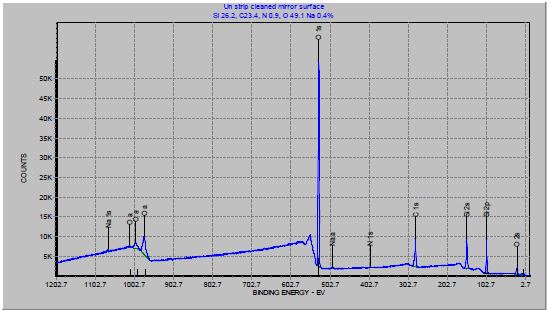 Figure 1 Unstripped mirror surface Figure 1 Unstripped mirror surface
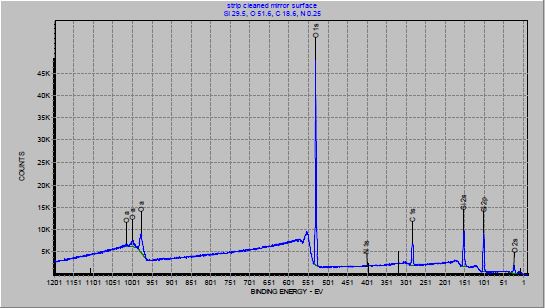 Figure 2 Strip cleaned mirror surface Figure 2 Strip cleaned mirror surfaceRespectfully Submitted, John S. Canham, Ph.D. Swales Aerospace, Inc. cc: 546/R Hedgeland 541/staff https://d.docs.live.net/f10fa703c3745096/Documents... Marketing ^0Sales/ESCA Report NASA GSFC Canham 2006.doc
This Report was Generated By Dr. John S. Canham, Swales Aerospace, Inc.
|