LIGO Laboratory / LIGO Scientific Collaboration 
California Institute of Technology
LIGO Project – MS 18-34
1200 E. California Blvd.
asadena, CA 91125
Phone (626) 395-2129
Fax (626) 304-9834
E-mail: [email protected]
|
a
|
Massachusetts Institute of Technology
LIGO Project – NW22-295
185 Albany St
Cambridge, MA 02139
Phone (617) 253-4824
Fax (617) 253-7014
E-mail: [email protected]
|
LIGO Hanford Observatory
P.O. Box 159
Richland WA 99352
Phone 509-372-8106
Fax 509-372-8137
|
|
LIGO Livingston Observatory
P.O. Box 940
Livingston, LA 70754
Phone 225-686-3100
Fax 225-686-7189
|
1 Objective
This document
explains the procedure
that was developed for use of first contact
in removing water-soluble contaminants.
How do I know? In the event a regular application of First Contact
per E1000079 does not leave a
pristine surface, it is likely that the contaminant is water-soluble. This can be verified by wetting a swab in
deionized water or spectroscopic grade water, wiping and immediately following
with an Isopropyl Alcohol or Methanol rinse.
This process works equally well in vertical
or horizontal application. Horizontal is easier.
2 Applicable Documents
E1000079
First Contact Application and Removal Procedure
E1000128 First Contact FTIR,
2010
T0900438
LIGO vacuum qualification of First Contact
T1000137 Drag Wiping
and First Contact Tests
T1000425 First Contact Hazard Analysis
T060161 FTIR and Residue tests, 2006
T070280 Photonic Cleaning
Technologies Technical Information
T0900351 FC Peeling and Charging
Tests
3
Materials
This is a 2 person job. Prepare, then get help.
List of required
materials, manufacturer and part number:
1. Red First Contact, Photonic
Cleaning Technologies Part#
FCL for 1 Liter
2. Red First Contact thinner,
Photonic Cleaning Technologies Part#TFCL for 1 Liter
3. Deionized or spectroscopic grade water > 0.25 liter
(~8 oz.)
4. First Contact spray bottle
– see “Care of spray bottles”
at the end of this document
5. Clean room gloves, VWR Part #79999-xxx or best current
glove
6. Texwipe
Alpha 10 or best current soft clean room fabric wipe. Big enough to completely
cover the surface to be cleaned
7. Lint-free Berkshire lenswipes, 9’’x9’’. VWR part number
52847-150
8. Acetone
9. Clean room Foil
10. Kapton tape
4
Preparation
1. Apply and remove
First Contact per E1000079 over as large an area as possible. This is to ensure there are no large boulders that
can be later rubbed into the surface.
2. Fill Water Bottle.
Fill a clean squirt bottle
with clean deionized water or spectroscopic grade water. At least 250
ml or ~8oz.
3.
Mix First Contact Spray 2 parts Red First Contact to
1 part Red First Contact Thinner (clear/red are NOT interchangeable) Test the spray on a piece of aluminum foil to be sure the pump is working and to get a feel for
how far away to hold the bottle to avoid drips.
4.
Control the mess. Protect bench top with clean
room foil or wipes for at least 2’ on all sides of the optic. Place clean room wipes along the barrel
of the optic, chain together
with kapton tape. Cover any prisms or ears.
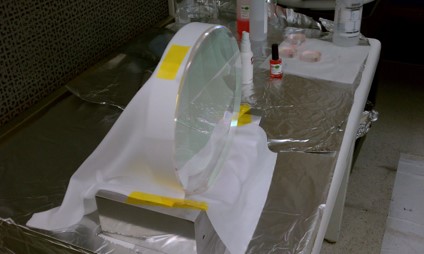
Figure 1: Mask to minimize overspray
mess
5 Application
1.
Soak clean room wipe.
Use ultraclean deionized water or spectroscopic grade water. Use a
wipe larger than the optic diameter. Multiple wipes may be used. The optic must
be continuously covered with water.
2.
Adhere and scrub. Let the wipe cling to the surface, minimize bubbles,
add water to be sure the surface STAYS
WET during the scrubbing. This
will make a mess. To scrub; move portions
of the wipe in small circles using your palm, raster to be sure you scrub every part of the surface. The
mechanical action is required in order to remove water soluble contamination.
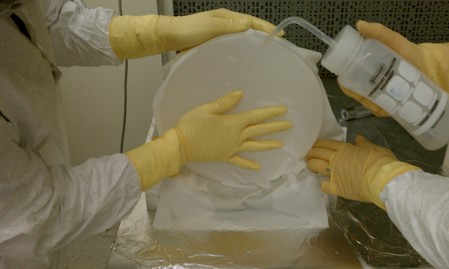
Figure 2. Scrub every part of the surface
1. Remove Horizontally. Being to pull the wipe horizontally, continue adding water to the wipe. As parts of the optical surface are exposed QUICKLY SPRAY one layer of First Contact on the surface as soon as it is exposed. It is imperative to NOT LET THE WATER EVAPORATE. It is OK of the spray gets on gloves and the wet wipe. It will run and look awful.
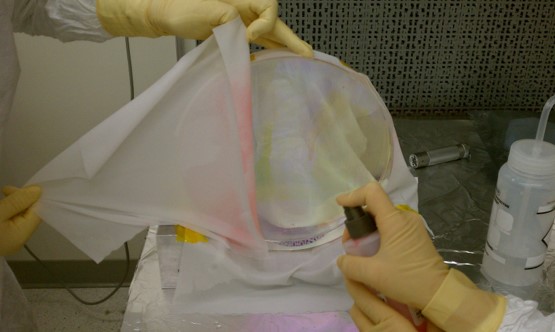
Figure 3: Spray First Contact
quickly before surface
dries
4.
Wait 1-2 minutes to allow
the first layer of First Contact to absorb the water.
5. Spray another full coverage
layer of First
Contact. Apply several
layers with 3-10 minutes in between applications until the First
Contact becomes clear and loses the cloudy appearance. Additional First contact
may be applied by brush our poured on until the layer is thick enough to stay
together for removal.
6. Remove per E1000079. Clean overspray from edges and bevels with Acetone and Berkshire
(paper) wipes.
6 Care Of Spray Bottles
Leaving for a short break – turn the first contact spray bottle upside down and spray into a solvent
disposal can, or onto foil, until the spray tube is empty and nothing comes out. Wipe the nozzle.
Leaving for a day or more – Insert the suction end of the spray tube into a beaker holding a few ml of thinner. Spray First Contact thinner through the nozzle into a disposal can to clean. End by removing the tube from the thinner and pumping air to clear the tube. Wipe the nozzle.
7 Additional Information
- First Contact (FC) has an expiration date of
1 year from the date of
purchase. (Colorless is 1 year, Red is 9 months)
- DO NOT use methanol
to wipe an optic that has been cleaned with FC. See T1000137 for reasons why.
- (If used) Each layer of brushed FC will
take about 20 minutes to set, i.e. to be dry enough to allow for the next layer to be applied. For three layers
it is good to leave
them overnight to ensure it is completely dry.
- Dry time is longer
at cooler temperatures.
- If the layer sticks
or stretches enough
to break while removing it is not dry yet. The dried film must leave the optic
in one single INTACT piece.
- If the dried film
is too thin it will break while peeling. If this happens, stop peeling and
brush another layer over the dry layer to make a thicker coating
and allow re-drying before peeling off again.
- When brushing on polymer
with a brush do not allow
bristles to scour
the optic surface.
|
|
|