|
Yan Baozhu, Yuan Shengfu, Zhou Qiong, Sun Quan and Yang Yi
College of Advanced Interdisciplinary Studies, National University of Defense Technology, Changsha, Hunan, P. R. China
Abstract: In high power laser system, it is very lethal of contamination on the surface of optical thin films The . contamination can be heated and burn rapidly under high power laser irradiation, which would result in damage to the optical thin films or contamination on even the whole optical component. Therefore, it is the key to control the the surface of optical thin films First Contact TM can be used to clean the surface of optical thin films, remove fingerprints, dust and other contamination attached to the surface of optical thin films. It has been applied in many important projects such as aLIGO. In this paper, the First ContactTM was used to clean the optical thin films for chemical lasers. A microscope was used to test the appearance of the optical thin films before and after cleaning, which showed that the First ContactTM is able to remove contamination such as fingerprints and dust attached to the surface of optical thin films for chemical lasers. The absorption coefficients of the optical thin films before and after cleaning were measured by an intracavity device, which is 286.5ppm and 216.9ppm respectively. The absorption coefficient was decreased by 28 24 % after cleaning. The above results show that the First ContactTM can effectively clean the optical thin films for chemical lasers, and there is no First ContactTM remain on the surface of optical thin films. It is found that the shortcoming of the First ContactTM is that it cannot repair the defect in the substrates or optical thin films of the optical components, and cannot clean the optical thin films online. Finally, the use of First ContactTM was optimized, and the optimized method is conducive to the long-term preservation of optical components.
Introduction: The control of contamination on the surface of optical thin films has always been the concern of the researchers in the field of high power laser (Raman RN, et al., 2016; Xiaofeng Cheng, et al., 2014; Kai Han, et al., 2016. In the process of high power laser systems, the power density on the optical thin films is very high. Then, the presence of contamination is fatal. Irradiated by the high power laser, contamination will be heated, even burning, and causing a damage of optical thin film. This is a serious thread to the stability and security of the system. First ContactTM is a kind of cleanser for optical surface, which is produced by a company called Photonic Cleaning Technologies. It is a mixture of solvents and (inert) polymers in a liquid form. When it is painted or sprayed on the optical surface, a soft layer of film is formed, and there is not any damage to the optical surface. When it is dry, it can be peeled off easily. At the same time, the contamination on the optical
surface is taken away, such as dust and handprint, then a clean optical surface
is left. First Contact
TM is used for removing
contamination on the surface of optical thin films in many projects, such as
aLIGO, which is short for advanced Laser Interferometer Gravitational Wave
Observatory (Margot H. Phelps, et al., 2013; Photonic Cleaning Technologies,
LLC, 2018). But there are no applications in chemical lasers. In this paper,
the cleaning method of optical thin films used for chemical lasers was studied
experimentally, and the
cleaning effect is tested by means of microscope and an
intra-cavity device (Xiaoting Fang, et al., 2015; Yan Baozhu, et al., 2015).
Cleaning Method: As shown in Fig.1, the steps of cleaning the surface of the
optical thin films with First Contact
TM are:
a) Firstly, one layer of First Contact
TM is sprayed on the
surface of the optical thin films, as Fig.1a;
b) 15 minutes later, a sticker is pasted on the layer of
First Contact
TM, then another layer of First ContactTM is sprayed on them, as
Fig.1b;
c) Another 15 minutes later, by tearing the sticker, double
layers are torn off simultaneously. The surface of optical thin film is very
clean as Fig.1c, and the removed film of First Contact
TM is shown as Fig.1d.
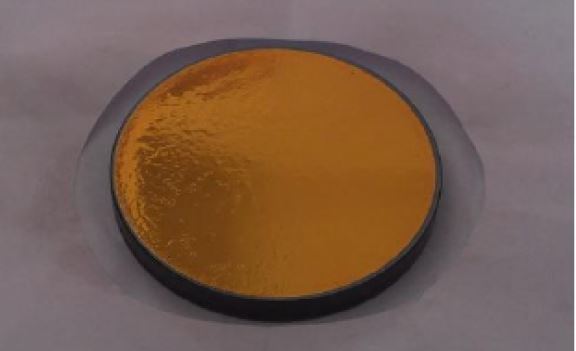
a.
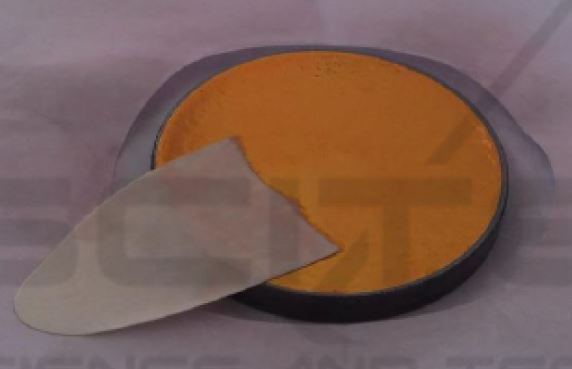 b. 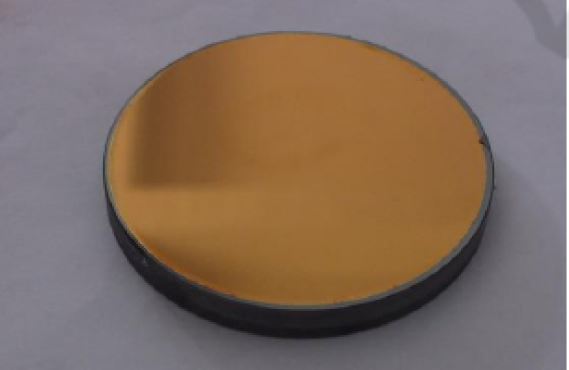 c. 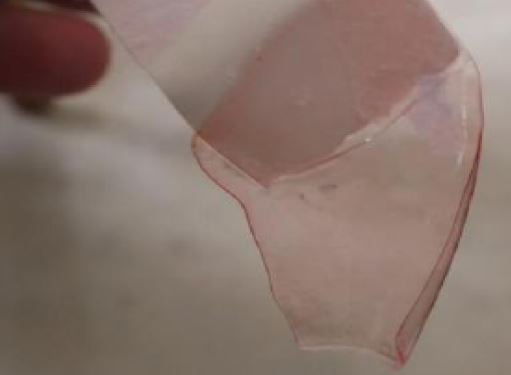 d. Figure 1: The cleaning process The removed film of First ContactTM is about 0.2
millimeter in thickness This thickness is more suitable (for removal). If too thin, the
First Contact
TM film is not strong enough (to resist tearing); if too thick, the First ContactTM film will (take longer to dry) In these two cases, the film will be easy to break (or will stretch) and can not be removed cleanly.
Cleaning Effect: Two methods are used to test the cleaning effect. The first
way is to compare the state of optical
film surface before and after cleaning by microscope. As shown in Fig.2a and Fig.2c, there are handprints and a lot of micron scale white
spots on the surface of optical thin film before cleaning. After cleaning, the
handprints are removed completely (as Fig.2b), and the number of white spots is
reduced significantly (as Fig.2d). It is found that some of the white spots are
contamination, and the others are defects in the substrate or optical thin
film. Contamination, such as dust, can be removed by the First ContactTM, and this is the reason for the decrease
of white spots. But defects in the substrate or optical thin film can not be
repaired, so there are still some white spots after cleaning. Another way is to measure the absorption coefficient
of optical thin film before and after cleaning by an intra-cavity device
(Xiaoting Fang, et al., 2015; Yan Baozhu, et al., 2015). As is shown in Fig.3,
an intra-cavity device is established based on a discharge-drived CW DF
chemical laser of hundred watt level. The center wavelength is about 3.8μm.
Utilizing an output mirror M2 with a low output coupling ratio (τ=0.03), the
intra-cavity device could produce a laser beam of about 2.5-6.5kW/cm2 and 1 cm2
in the resonant cavity. When placed in the resonant cavity, the testing mirrors
S1~S4 are irradiated by the laser beam of high power density. In the test, the
irradiation is lasting 100 seconds continuously, and the equilibrium
temperature rise of the substrate after the irradiation can be measured by
temperature sensors, which are pasted at rear surface of testing mirrors S1~S4.
The output power is measured by power sensor. Then, the absorption coefficient
of optical thin film can be calculated by calorimetry. Five times of
measurements are carried out by use of the intra-cavity device in this paper,
and the absorption coefficients of optical thin film are listed in Tab.1. The
Pd, E, △T
and α represent power density of laser beam in the resonant cavity, energy radiated
on the optical thin film, equilibrium temperature rise of the substrate after
the irradiation, and absorption coefficient respectively.
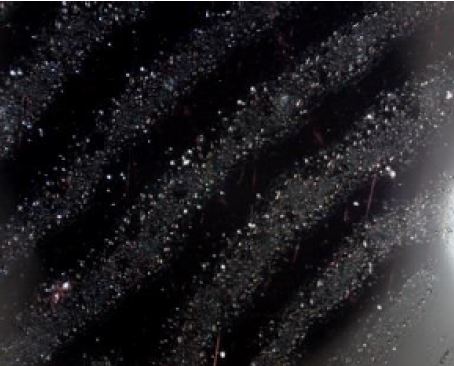
Fig 2a. Handprints on the surface before cleaning
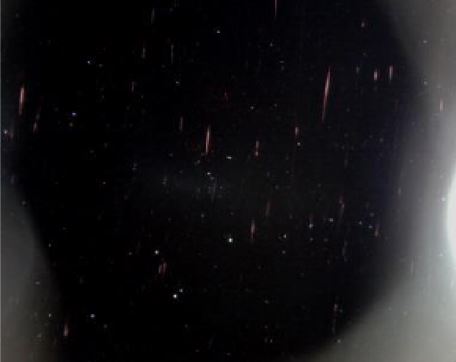
Fig 2b. The position of handprints after cleaning
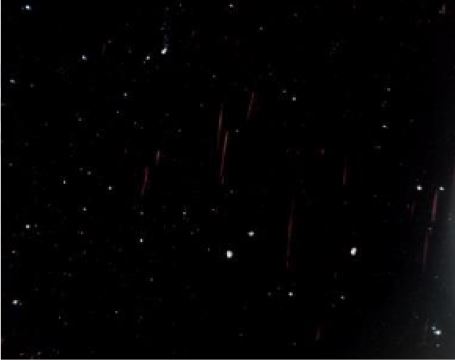
Fig 2c. White spots on random are outside handprints before cleaning
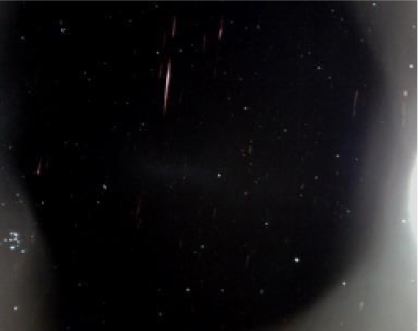
Fig 2d. Random are outside of handprints after cleaning
Figure 2: The cleaning effect of First Contact
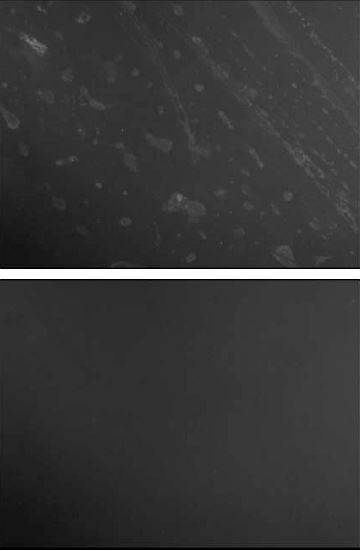
Figure 3: Layout of intra-cavity device
The first three times of measurements are carried out before
cleaning, and the average value of absorption coefficients is 286.5ppm. After
cleaning by First ContactTM, two
more measurements are made. The average absorption coefficient is 216.9ppm,
which is 24.3% less than the value before cleaning. The reason for the decline
is the removal of dust and other contamination on the surface of optical
thin film. On the other hand, the results reveal that the layer of First
ContactTM is torn off completely,
and there is no residue on the surface of optical thin film. There is no new (contamination)
to the optical film, which is of great practical significance.
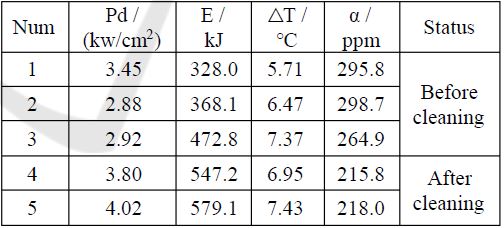
Table 1: The absorption coefficients measured by the intra-cavity device
Protection of Optical Components: One layer film is formed when First ContactTM is sprayed on the surface of the
optical thin film. The layer of First ContactTM
can isolate optical thin films from water vapor and prevent it from being
damaged by other things. So First ContactTM
can be used for protecting optical components during preservation and
transportation. In order to explore the method of using First ContactTM to protect optical thin films, two
layers of First ContactTM
are sprayed on the surface as step a and b in the part 2. One week later,
double layers can still be torn off completely, but a imprint like watermark
appeared on the surface of optical film, as shown in Fig.4, and there is a
clear boundary around the sticker The imprint can be removed by using First
ContactTM again, but the boundary
can’t.
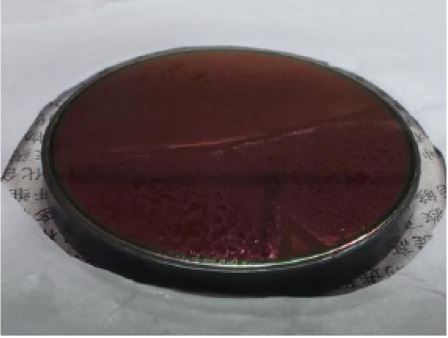
Figure 4
Thus, (our) spraying method need to be optimized. After spraying the first layer of First ContactTM on the surface of the optical thin films, the white, oval, sticky peel tab is not pasted immediately. When the optical component need to be used, maybe a few days later, (apply) a peel tab, (then) tear off the peel tab and the layer of First ContactTM. Tests verify that using the optimized method the layer of First ContactTM can be torn off completely even 3 months after spraying and there is no boundary around the sticker. If there is a watermark-like imprint on the surface of optical film it can be cleaned by use of the method in part 2 again.
Conclusions: In this paper, the cleaning method of First ContactTM to the surface of optical thin films is
studied experimentally. The test results of the microscope and the intra-cavity
device reveal that, the cleaning effect of First ContactTM is perfect, and there are no negative
effects, such as pollution and damage. But the defects of substrates or optical
films can not be repaired by First ContactTM.
The layer of First First ContactTM
can be torn off completely even 3 months after spraying, so it may be used for
protecting optical components when preservation and transportation.
|